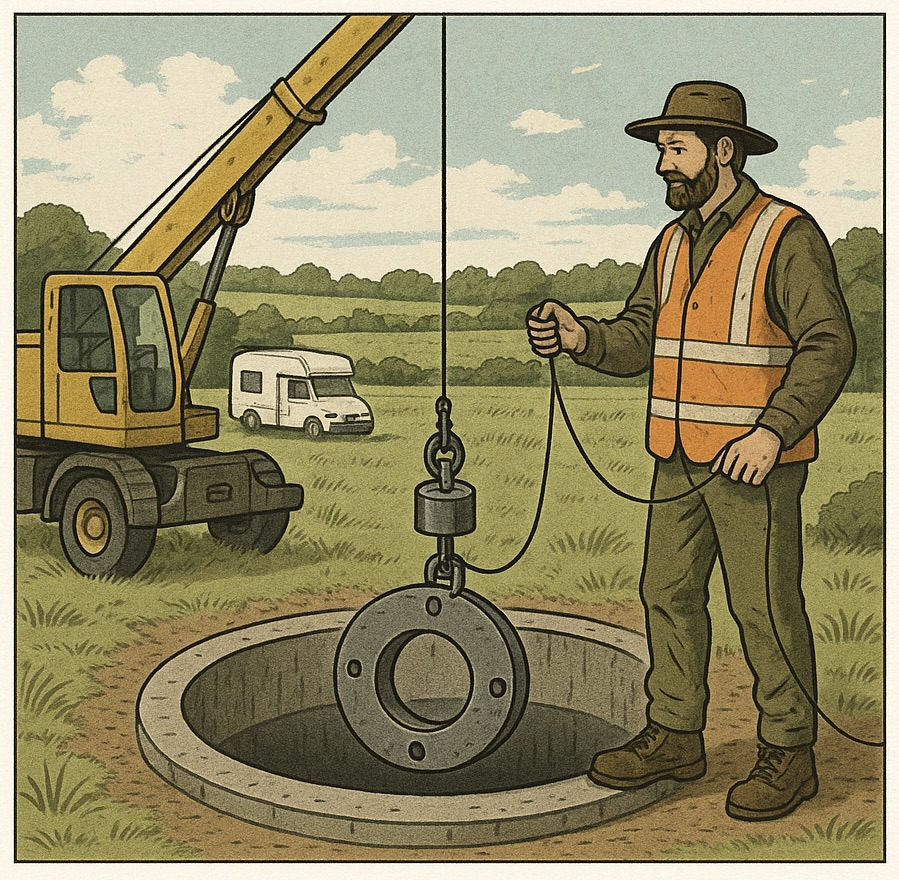
This project has been one of the more bizarre assignments in my nomadic geological journey—part hydrogeology, part engineering, and part good old-fashioned fishing. I found myself deep in the rural heart of Shropshire, parked up in my campervan just two fields from the site. It was one of those rare setups where I could stroll to work, boots still damp with morning dew, through hedgerows humming with birdsong. Pure countryside bliss—if you ignore the 100-metre death hole.
Let me explain.
I was contracted to assist in the cleaning of an existing groundwater extraction borehole. But here’s the twist—there was no drill rig, no rock dust, no core samples. Just a crane, some burly drillers from up north, and a 10-ton, 6-metre-long, 24-inch-wide cylindrical brush that looked more like a medieval siege weapon than a piece of hydrological equipment. This thing had been custom-built for the job, because the borehole was massive—so wide a person could easily fall in and keep falling for a full 100 metres. And standing on the edge, even in a harness, gave me that primal feeling you get at the edge of a sea cliff: a weird internal lurch that says, Don’t jump, don’t jump, even though you’d never dream of it.
The borehole itself serves a strange purpose. Groundwater is pumped from this point to feed back into the nearby river—an artificial recharging effort to maintain river levels at the spot where water is abstracted for human use. So, in essence, water is being removed from the ground only to be put back into the system from another angle. Necessary, apparently!
Then came the fishing mission.
Some rogue steel had been dropped down the borehole years ago. A job for some high-tech equipment, right? Wrong. This was no fancy operation. It was just us and a magnet on the end of a long piece of string, bobbing it up and down like kids hoping for a tin can at the bottom of a well. Two full days of this low-tech wizardry, and finally—clunk. We pulled it out like victorious anglers, cheered on by tea in steel mugs and sarcastic commentary from the lads.
Now, the drillers—let’s just say they were proper northern blokes. Salt of the earth, heavy on the banter, and not always tuned in to the delicate sensibilities of a soft-spoken southern geologist like myself. Conversations were… navigated. Sometimes avoided altogether. But their work ethic? Impeccable.
After the cleaning, we ran a downhole survey, gave the pumps a good test run, and called it a job well done. The borehole sparkled like a freshly brushed chimney—if chimneys ran a hundred metres straight into the ground.
Not a single rock sample, not a sliver of core, no fossils or faults. Just steel, water, and a magnet on a string.
Sometimes geology isn’t about the rocks you see. Sometimes, it’s about the ones you don’t. And sometimes, it’s just about not falling in the bloody hole.
Until next time,
The Nomadic Geologist
 The Nomadic Geologist
Leave a comment